
Influence Knowledge Brief
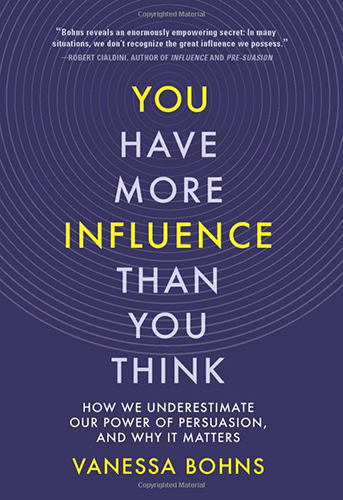
You Have More Influence Than You Think
by Vanessa Bohns
In You Have More Influence Than You Think, Vanessa Bohns explores the ways in which people underestimate their own ability to persuade and influence others. The book draws on Bohns’ own research and other studies in social psychology to demonstrate that individuals have more power to shape the behavior and decisions of those around them than they realize. By better understanding the factors that contribute to persuasion and influence, readers can learn to harness these abilities more effectively and ethically in various areas of life, from personal relationships to professional settings.
AUTHOR’S BACKGROUND
Vanessa Bohns is an associate professor of organizational behavior at Cornell University and a social psychologist. Her research focuses on social influence, prosocial behavior, and the psychology of compliance and consent.
THE ONE BIG IDEA
People consistently underestimate their influence on others, which can lead to missed opportunities, unnecessary awkwardness, and harmful consequences. By recognizing and embracing our powers of persuasion, we can improve our relationships, careers, and lives.
Key Insights
- People often underestimate their ability to influence others, which can result in missed opportunities for personal and professional growth.
- This underestimation of influence can stem from a lack of awareness of the subtle cues and signals that contribute to persuasion.
- Understanding the psychology of persuasion can help us recognize our own influence and use it more effectively.
- Social norms, authority, and empathy are key drivers of influence, and can be harnessed to increase our persuasive power.
- Being aware of the power dynamics in a given situation can help us navigate it more effectively and ethically.
- Embracing our influence can lead to better outcomes in our personal and professional lives, but should always be used responsibly and ethically.
Action Steps
REFLECT
KEY DRIVERS
SIGNALS & CUES
POWER DYNAMICS
EMBRACE IT
Personalized Takeaways
Pay attention to situations where you may have underestimated your influence and consider how embracing your persuasive abilities might have led to a different outcome. Work on developing a deeper understanding of the psychology of persuasion to improve your ability to navigate social and professional situations. Practice using your influence more effectively by focusing on social norms, authority, and empathy in your interactions with others. Always be conscious of the power dynamics at play and use your influence ethically and responsibly.
Learn More
- Influence: The Psychology of Persuasion by Robert B. Cialdini
- Pre-Suasion: A Revolutionary Way to Influence and Persuade by Robert B. Cialdini
- The small BIG: small changes that spark big influence by Steve J. Martin, Noah Goldstein, and Robert Cialdini